tap anywhere to enter
When a student misspells a word, you see the mistake — but not the thinking. Atlas captures the thinking, sound by sound, so you can see exactly where decoding breaks down. Free for teachers, tutors & parents during beta.
Takes 30 seconds · No card, ever · See how it works →
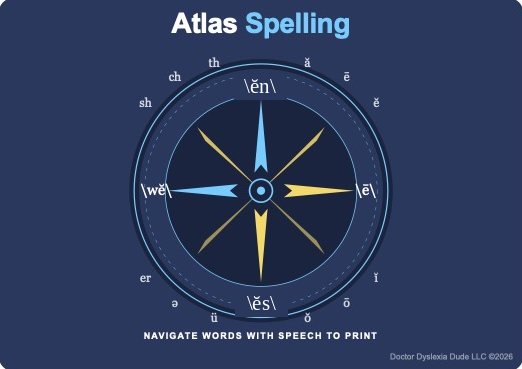
It starts simple: a student types a word and Atlas fills in the Merriam-Webster pronunciation and syllables. From there they map each sound to the letters they choose — so you see the thinking behind the spelling.
See all four steps →A look at Step 1 — word setup.
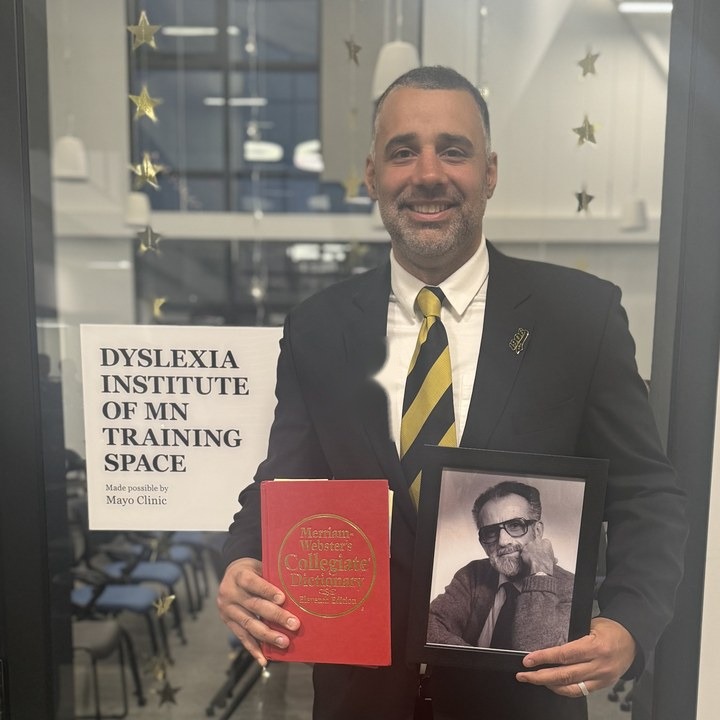
I am Shawn Anthony Robinson, PhD — most people know me as Doctor Dyslexia Dude. I graduated high school reading at an elementary level, and was first taught to love the structure of language as a freshman in college at the age of 18. Throughout my college, master's, and PhD journeys, I had educators fail and discourage me; many instructors failed me academically, and I had to retake courses. Even as a doctoral student, formal evaluations showed my reading still tested behind. Professionals were quick to tell me what I got wrong. No one could ever show me how I was thinking when I tried to build a word.
This June of 2026 marks 30 years that I have studied the Merriam-Webster dictionary — sound by sound, syllable by syllable. I earned a doctorate in Language & Literacy, was inducted into the Reading Center Hall of Fame, and have shared this work nationally and internationally — from MIT's Science of Reading Symposium to the International Conference on Historical Lexicography at the University of Westminster. As a Research Affiliate at the University of Wisconsin–Madison, I published the decoding method that is the engine behind Atlas Spelling™ © 2026.
Atlas doesn't grade, correct, or judge. It captures how a learner orthographically maps speech to print — exactly the thinking I was never able to show my own teachers. I built it so the next struggling speller gets seen, not just scored.
Read my story: “How a Dictionary Changed My Life” →
Explore the award-winning Doctor Dyslexia Dude graphic novels →
Atlas is an early beta, grounded in historical research across different academic disciplines, the foundational work of Dr. Robert T. Nash, as well as me studying this specific field and the Merriam-Webster's dictionary for 30 years. No claims are being made — just looking for teachers and students to tell us what's useful, what's missing, and what to build next. During beta, every feature is unlocked and free, and your feedback shapes where Atlas goes.
When a student spells a word wrong, you see the mistake. But you don't see the decision-making. Is it a phoneme issue? A pattern problem? An orthographic mapping mistake? You're guessing.
Four steps. One recorded session. No grading. No correction. Just capturing exactly how the student thinks.
The platform does not grade, correct, or intervene. It records exactly what the learner decided by capturing how sounds are mapped to letters, using Dr. Nash's Pure and Complete Phonics and Merriam-Webster pronunciation symbols, preserving each entry for instructional review.
Atlas Spelling™ © 2026 is built on Dr. Robert T. Nash's Pure and Complete Phonics—a phonics program rooted in Orton-Gillingham methodology, refined over 40+ years of instruction with struggling readers and students with dyslexia. From 1996 until Dr. Nash's passing in 2017, our founder Shawn Anthony Robinson, PhD, trained directly under him—a two-decade apprenticeship. In 2025 he revised and extended Nash's instructional text, carrying that lineage directly into Atlas.
Atlas implements the decoding framework our founder, Shawn Anthony Robinson, PhD, published in 2025 as a Research Affiliate at the University of Wisconsin–Madison: mapping sounds to letters with Merriam-Webster's pronunciation symbols and the six syllable types, drawn from an analysis of 405 complex words.
Student names are excluded from all LLM processing and logs. Session IDs are opaque. Teacher rosters use their own labels. School district deployments require a Data Privacy Agreement. This tool respects the data sensitivity of educational records.
This represents over 30 years of self-discipline and work — 168 pages of words presented through a consistent visual structure that makes syllables, pronunciation, and sound–spelling relationships clear and repeatable. Each word is not just shown — it's revealed. This structure gave me a way to actively work through words — making decoding and spelling decisions step by step, building real understanding over time. This is where word structure becomes understanding. Note: some words appear more than once across pages — repetition is intentional and part of the learning process.
View all 168 pages ↗Opens in Google Drive · PDF format
Shawn Anthony Robinson, PhD has spent 30 years studying the Merriam-Webster dictionary, lexicography, and its relationship to decoding and reading instruction.
Atlas is grounded in historical and modern scholarship on teaching and learning, and 30 years of studying and application. This platform is an early beta, and we need YOU to help answer the real question: Does this help us understand how students spell by orthographically mapping speech to print?
Use it with your students for one month. See what works. See what breaks.
What do you actually need in the dashboard? What would make this useful for YOUR classroom?
Your feedback directly changes the product. You're not just testing—you're building.
The core spelling tool is free — now and after launch. During beta you also get every premium feature unlocked. No cost, no strings.
Select your role to get started.